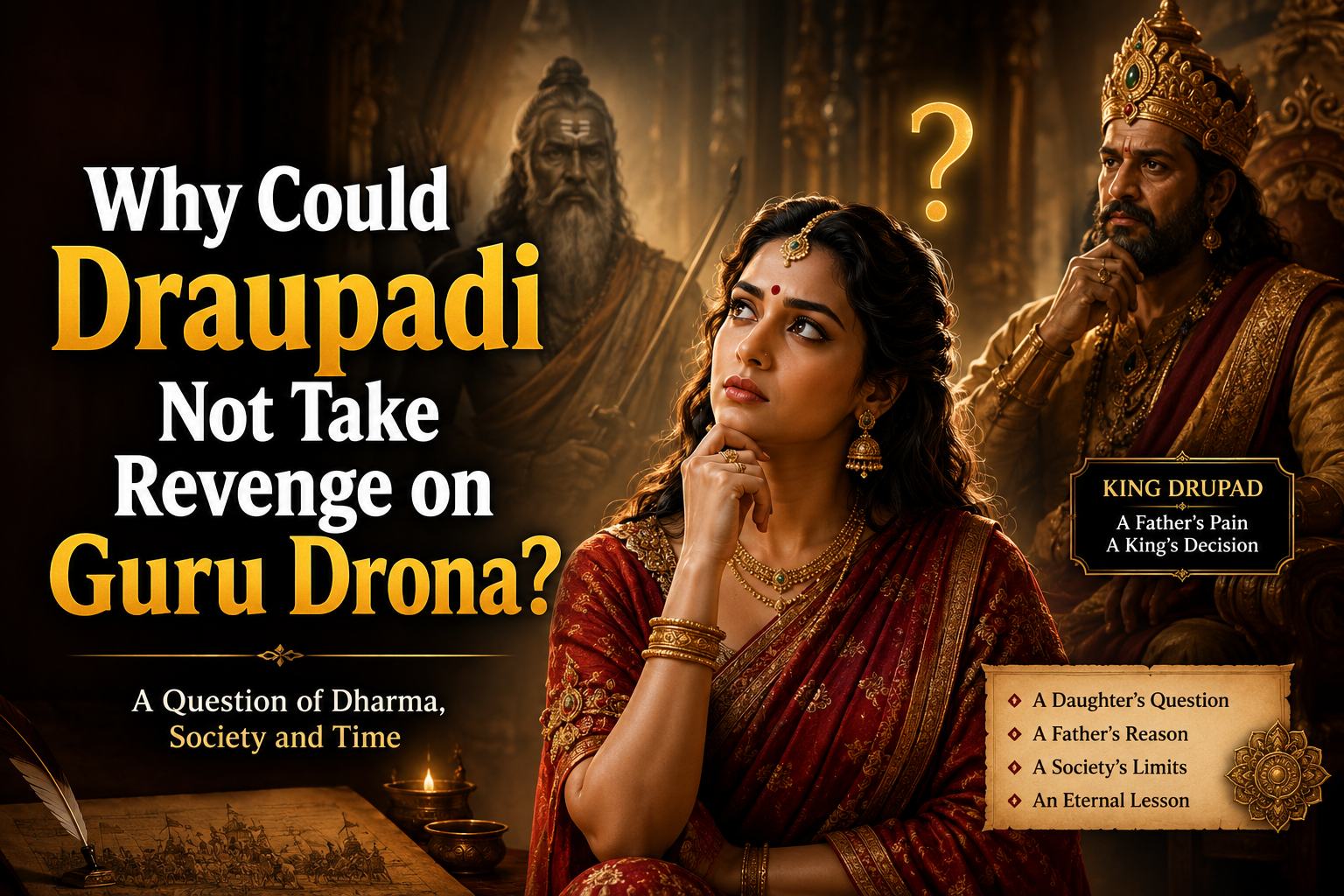
Why Could Draupadi Not Take Revenge on Guru Drona?
A Daughter's Inner Conflict
Among the countless episodes of the Mahabharata, Draupadi's character stands out as one of the most complex and thought-provoking. She was not merely the wife of the five Pandavas—she was a woman courageous enough to question the traditions of her era.
From childhood, one question repeatedly troubled her mind. When her father, King Drupad, desired a child solely to avenge his humiliation at the hands of Guru Drona, why did he specifically wish for a son? Could a daughter not have fulfilled that responsibility?
The thought returned to her again and again. If Goddess Durga could defeat the mighty demon Mahishasura, and if Goddess Shakti had destroyed countless demons, then why could a daughter not defeat a warrior like Guru Drona? This question deeply stirred her soul.
The Answers of Her Mother and Father
When Draupadi asked this question to her mother, she received an answer shaped by the customs of the time. Her mother explained that daughters were not trained in weapons or warfare during that era, making participation in battle impossible. Women were not allowed on the battlefield—not because of personal choice, but because society itself had established those boundaries.
King Drupad shared the same reasoning. He explained that Dronacharya was no ordinary warrior. Defeating him was considered nearly impossible for anyone except Lord Shiva, Lord Vishnu, Indra, and Parashurama. No father, he believed, could willingly send his beloved daughter into such a dangerous mission.
Dharma, Propriety, and the Limits of the Age
This conversation makes it clear that Draupadi's inability was not due to a lack of strength or determination, but because of the social structure of the Dvapara Yuga.
Society had already defined the role of women as life-givers and nurturers rather than warriors. Sons were trained in warfare and prepared for battle, while daughters were kept outside that sphere.
King Drupad also made a significant observation: human beings are not shaped solely by logic; they are products of their society, their era, and their circumstances. This reflects how even decisions that seem unequal today were influenced by the social realities of that period.
Conclusion
Draupadi's question remains meaningful even today. It reminds us that there is often a significant difference between ability and opportunity.
Draupadi possessed courage, intelligence, and strength, yet the structure of her age denied her the opportunity that was naturally given to her brothers.
That is why she could not personally take revenge on Guru Drona—not because she lacked the capability, but because she was bound by the social limitations of her time.