
How Draupadi Secretly Learned Politics and Law From Behind Her Father’s Throne
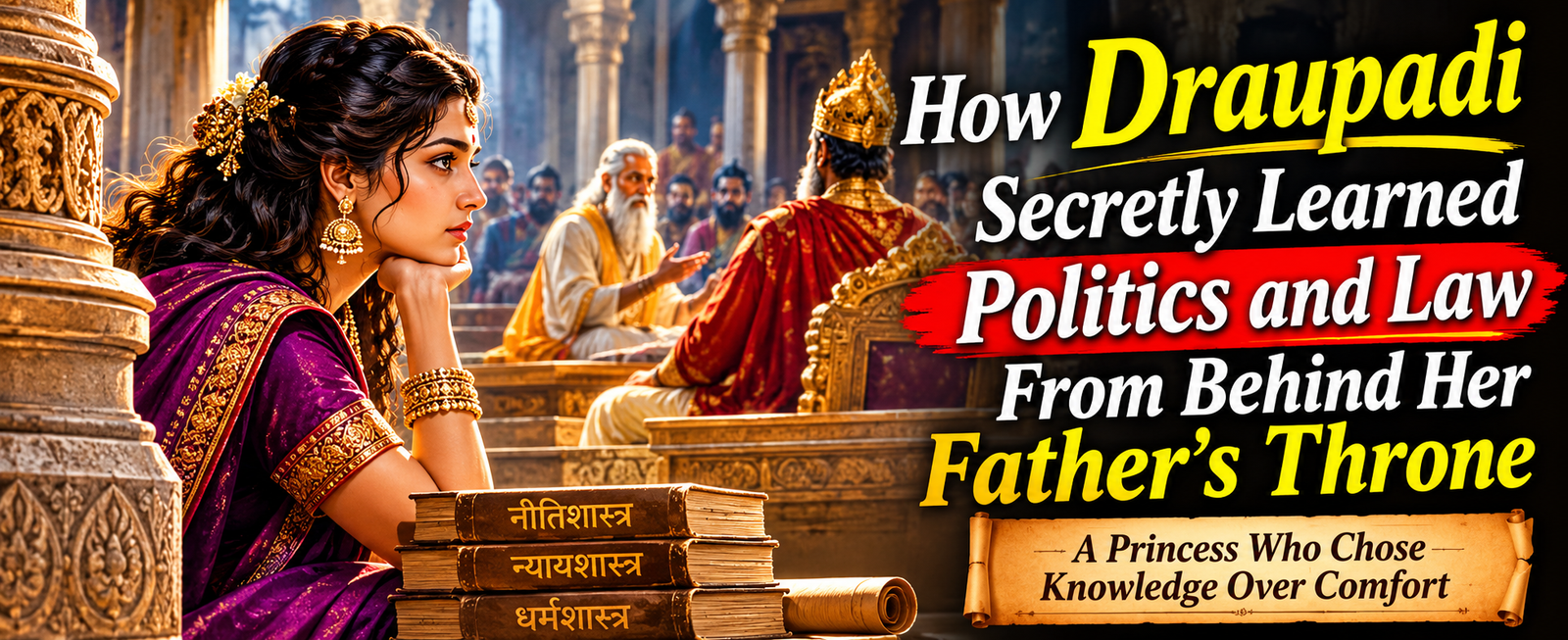
While her friends mastered dance, music, and painting, Draupadi was doing something almost no other princess of her time did: sitting quietly at the edge of the royal court, absorbing lessons in statecraft that weren’t meant for her. Here, in her own words, is a rare, specific description of exactly how she educated herself in politics, law, and diplomacy often against her parents’ wishes.
Hidden in the Corner of the Rajya Sabha
Draupadi describes a habit that set her apart from every other girl in the palace: she would often sit tucked away in a corner of the Rajya Sabha (royal court), behind her father, listening to the proceedings of the state. At first, she understood very little of what was being discussed. But gradually, her comprehension grew. She didn’t stop at the main court.
She did the same in the smaller council of ministers’ meetings sessions where logic, argument, and diplomatic strategy were openly debated. This wasn’t a one-time curiosity; it was a repeated, deliberate habit.
Defying Her Parents to Keep Learning
Notably, this wasn’t something her parents encouraged. She says her father and mother generally tried to stop her from these sessions. But her own stubbornness the same trait that made her different from other princesses meant she kept finding ways to attend anyway, picking up more each time. She describes herself as being “compelled by her own nature,” with her curiosity keeping her restless until she’d learned what she wanted to know.
The Subjects She Loved Most
Among everything available to her, Draupadi says her deepest interest was in three specific fields: neeti-shastra (political ethics/policy), nyay-shastra (justice and law), and dharmashastra (theology and moral law). This is a meaningful detail. She was, by her own account, taught daily that for women, the definition of “correct conduct, justice, and duty” simply meant obeying parents, husband, in-laws, guru, and elders. She says she accepted this teaching as did her friends. But acceptance wasn’t the end of her curiosity. She wanted to study these subjects justice, ethics, and dharma directly, on her own terms, rather than only through the lens of obedience.
Why Her Father Eventually Gave Her a Royal Guru
Her friends, she notes, had no interest in these subjects at all and were taught them only in very limited amounts, as was standard. Draupadi’s interest, by contrast, was deep she wanted complete, thorough knowledge. Eventually, her father arranged a high-caliber royal guru specifically for her.
From then on, she would take dedicated time to visit her raj-guru and discuss questions of justice, policy, and dharma directly with him. She admits, with a hint of humor, that her constantly questioning nature “troubled him too” a small detail that suggests she wasn’t a passive student even with a personal tutor.
Learning From Visiting Sages
Draupadi’s education wasn’t limited to formal court sessions. Whenever a great rishi, maharishi, saint, muni, or mahatma visited the kingdom, the state would arrange special hospitality for them. With permission from her rajguru or her parents, she would take on the service of these visiting sages herself. She admits their deep, profound conversations were often hard to follow at first but she says she learned a great deal, quickly. In fact, she describes these periods so vividly that she says everything else in life felt “worthless” by comparison while she was absorbed in these discussions.
A Contrast in Priorities
There’s a clear, deliberate contrast here: while her fellow princesses were occupied with cooking, household management, dance, music, and painting fields where several of them, and some of her own cousins, achieved real mastery Draupadi stayed immersed in the Vedas, shastras, and books. She had even begun reading books specifically on political science (rajniti-shastra) and law (nyay-shastra), subjects almost entirely absent from the education of the princesses around her.
Conclusion
Long before she became known for her role at Kurukshetra or in Hastinapur’s court politics, Draupadi was already a student of statecraft quietly, persistently, and often against her parents’ wishes. The image of a young princess hiding behind her father’s throne to understand how a kingdom is actually run reframes her later political sharpness not as sudden or accidental, but as the result of years of deliberate, self-driven study that started long before anyone expected it of her.