Draupadi’s Unconventional Personality: Why She Was Called “Ardh-Purush” (English) Called “Ardh-Purush”
Introduction
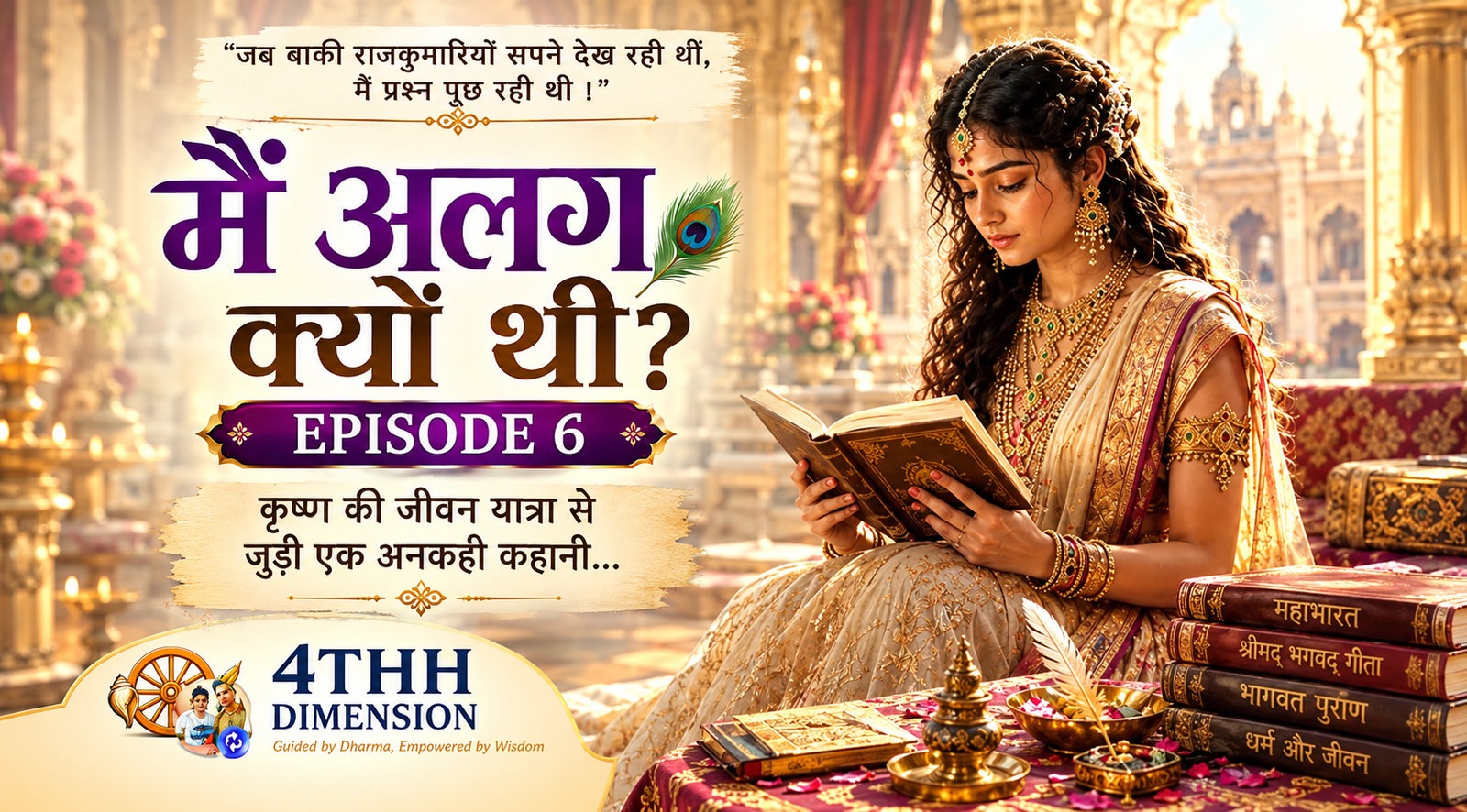
She Had Almost No Friends And She Knew Exactly Why
The “Ardh Purush” Label
A Different Definition of Success
For the other girls and princesses around her, she explains, life had one clear goal: becoming the most capable wife, daughter-in-law, and mother possible. Their entire education was built around it pleasing a husband, serving in-laws, raising children, running a household, managing every domestic responsibility, and caring for the extended family.
Draupadi says she had far less interest in this path, which is also why she had little connection with the elder women nurses and female gurus whose job was to teach it. Importantly, she’s careful to clarify that she was still learning these skills, and still wanted to. Her issue wasn’t with the path itself. It was that she wanted more.
I Wanted to Live Like the Unlimited Sky
This is the philosophical core of her story. Draupadi says she wanted every colour of life wife, daughter-in-law, and mother, yes, but also everything beyond that. She refused to live what she calls a “limited life,” describing her ambition in vivid terms: to live like the boundless sky, the infinite space not confined to the roles of wife, daughter-in-law, and mother alone, but free to fly on her own wings across the whole expanse of what a life could be.
Not Right or Wrong A Question of Choice
What makes Draupadi’s account stand out is that she refuses to turn this into a moral argument. She states plainly that she is not saying her friends the ones who became devoted wives and mothers — were wrong, or doing something inferior. She’s equally clear that she isn’t claiming to be “right” in some superior sense either.
Her friends chose to become wives, mothers, and daughters-in-law, and she says plainly there was nothing wrong in that choice; they were being true to their own nature, and they were happy.
She, on the other hand, chose an unlimited life one that also included struggle and hardship by definition, alongside politics, dharma, ethics (neeti-shastra), justice (nyay-shastra), diplomacy, and statecraft. In her words, she was equally right in her own place, on her own terms.
Why This Still Matters
Strip away the Dvapar Yuga setting, and this reads like a strikingly contemporary reflection on identity: a woman naming the exact ways she didn’t fit the expected mould, being mocked for it, and refusing either to change herself to fit in or to condemn the women who chose the traditional path instead.
It’s a rare moment in Mahabharata adjacent storytelling where the tension between individual identity and social expectation is addressed directly, in the character’s own words, without being resolved into a simple moral.