Draupadi’s Unconventional Personality: Why She Was Called “Ardh-Purush”
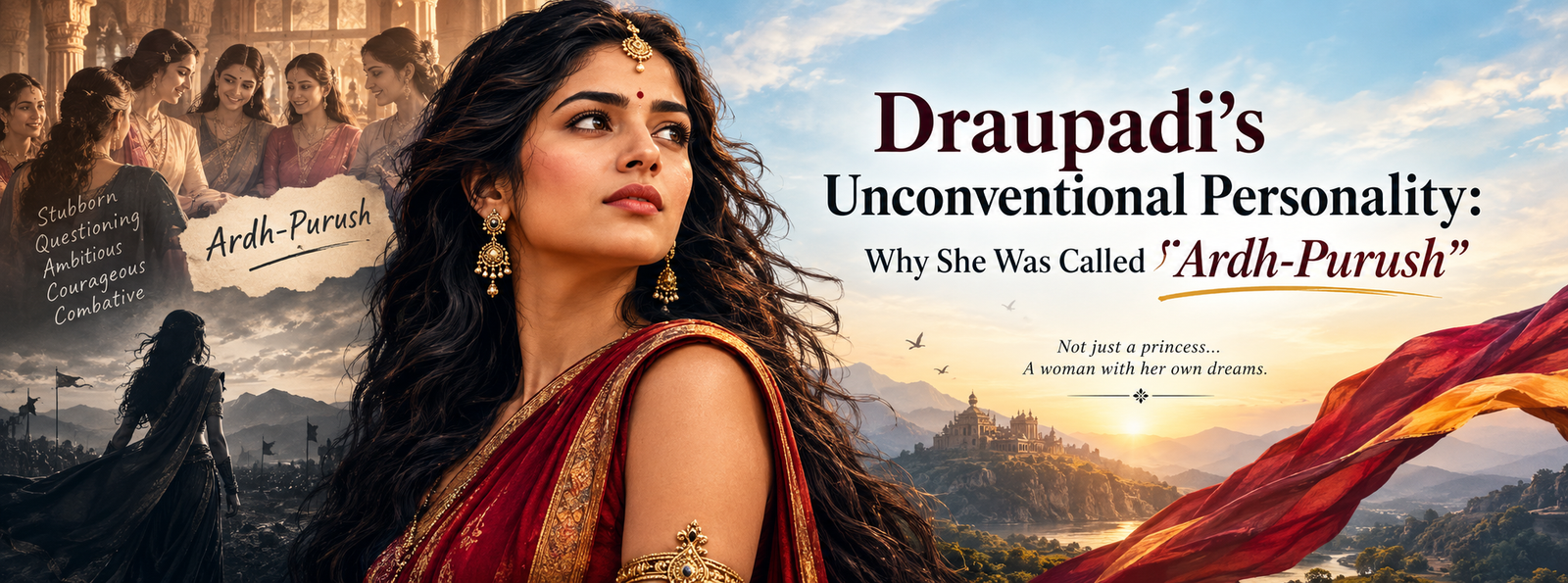
Most retellings of Draupadi focus on the swayamvar, the game of dice, or her role in the Kurukshetra war. Episode 6 of this first-person account steps back from all of that and asks a quieter question: what was Draupadi actually like as a young woman growing up in the palace? Her answer is candid, unapologetic, and strikingly modern — a portrait of a princess who never fit the mould built for her, and who eventually stopped trying to.
She Had Almost No Friends — And She Knew Exactly Why
Draupadi recalls having only four or five friends, despite real effort from both sides. She tried to build friendships
with the other palace princesses; they tried just as hard to befriend her. Her parents and brothers actively
encouraged her to bond with girls her own age. None of it worked, and she eventually accepted this as simply true
about her life rather than a problem to keep solving.
The “Ardh Purush” Label
That mismatch didn’t go unnoticed by the people around her. She recalls being told she was “a girl only in body a man in mind.” Some mocked her, half affectionately, as “half woman, half man.” Others used a specific term for it: ardh purush Draupadi “half man Draupadi.” Even her own name, she notes, was sometimes used as a taunt.
A Different Definition of Success
For the other girls and princesses around her, she explains, life had one clear goal: becoming the most capable wife, daughter-in-law, and mother possible. Their entire education was built around it pleasing a husband, serving in-laws, raising children, running a household, managing every domestic responsibility, and caring for the extended family.
I Wanted to Live Like the Unlimited Sky
Not Right or Wrong A Question of Choice
Why This Still Matters
Strip away the Dvapar Yuga setting, and Episode 6 reads like a strikingly contemporary reflection on identity: a woman naming the exact ways she didn’t fit the expected script, being mocked for it, and refusing either to change herself to fit in or to condemn the women who chose the traditional path instead. It’s a rare moment in Mahabharata-adjacent storytelling where the tension between individual identity and social expectation is addressed directly, in the character’s own words, without being resolved into a simple moral.
Conclusion
Episode 6 doesn’t try to make Draupadi likeable or unlikeable — it simply lets her explain herself. Stubborn, questioning, mocked as “ardh-purush,” and unwilling to shrink her ambitions to fit a template built for someone else, she comes across less as a mythological figure and more as a young woman working out, in real time, what kind of life she actually wants — and defending her right to choose it without needing to declare anyone else
Draupadi’s Unconventional Personality: Why She Was Called “Ardh-Purush”
Most retellings of Draupadi focus on the swayamvar, the game of dice, or her role in the Kurukshetra war. Episode 6 of this first-person account steps back from all of that and asks a quieter question: what was Draupadi actually like as a young woman growing up in the palace? Her answer is candid, unapologetic, and strikingly modern — a portrait of a princess who never fit the mould built for her, and who eventually stopped trying to.
She Had Almost No Friends — And She Knew Exactly Why
Draupadi recalls having only four or five friends, despite real effort from both sides. She tried to build friendships with the other palace princesses; they tried just as hard to befriend her. Her parents and brothers actively encouraged her to bond with girls her own age. None of it worked, and she eventually accepted this as simply true about her life rather than a problem to keep solving.
The “Ardh Purush” Label
That mismatch didn’t go unnoticed by the people around her. She recalls being told she was “a girl only in body a man in mind.” Some mocked her, half affectionately, as “half woman, half man.” Others used a specific term for it: ardh purush Draupadi “half man Draupadi.” Even her own name, she notes, was sometimes used as a taunt.
A Different Definition of Success
For the other girls and princesses around her, she explains, life had one clear goal: becoming the most capable wife, daughter-in-law, and mother possible. Their entire education was built around it pleasing a husband, serving in-laws, raising children, running a household, managing every domestic responsibility, and caring for the extended family.
I Wanted to Live Like the Unlimited Sky
Not Right or Wrong A Question of Choice
Why This Still Matters
Strip away the Dvapar Yuga setting, and Episode 6 reads like a strikingly contemporary reflection on identity: a woman naming the exact ways she didn’t fit the expected script, being mocked for it, and refusing either to change herself to fit in or to condemn the women who chose the traditional path instead. It’s a rare moment in Mahabharata-adjacent storytelling where the tension between individual identity and social expectation is addressed directly, in the character’s own words, without being resolved into a simple moral.
Conclusion
Episode 6 doesn’t try to make Draupadi likeable or unlikeable — it simply lets her explain herself. Stubborn, questioning, mocked as “ardh-purush,” and unwilling to shrink her ambitions to fit a template built for someone else, she comes across less as a mythological figure and more as a young woman working out, in real time, what kind of life she actually wants — and defending her right to choose it without needing to declare anyone else