4thh Dimension 4thh Dimension
Draupadi
AAVYAMN KREATIVEA LLP 17 Jul 2026

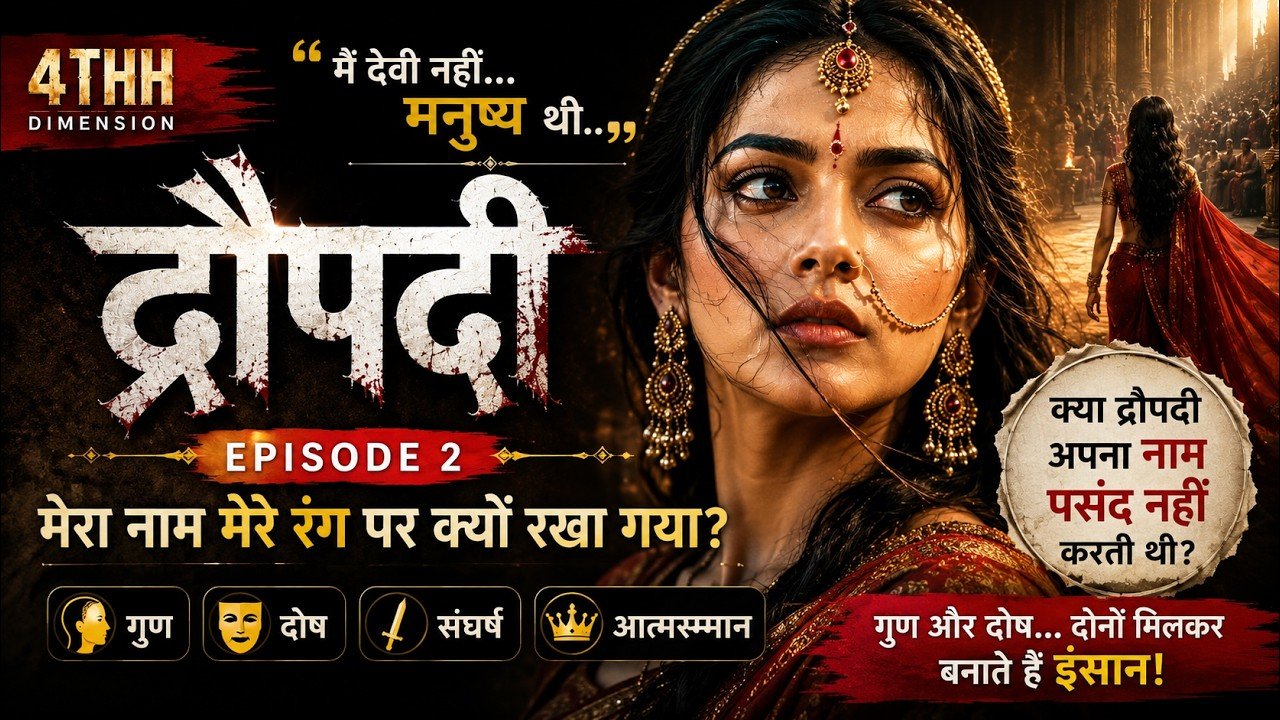
Draupadi's Naming Did I Even Like My Own Name?
Draupadi's Naming Did I Even Like My Own Name?
Dhrishtadyumna and Me — A Difference in NamingAfter the yagna was completed, the sages present there named the divine boy Dhrishtadyumna. They explained that this young man would be a proud, fearless, unforgiving, and mighty warrior — bold to the point of audacity. And since he was born from the flame of the sacrificial fire, from the very altar of the yagna, the name "Dhrishtadyumna" fit him perfectly. Our father was pleased — his son's name was chosen to reflect his nature and character. That is exactly how it should have been.

Then came my turn. And that is where the story changes.

Because my complexion was dark, I was named Krishna — on that basis alone. My name rested on the colour of my skin, not on my qualities, my nature, or my character, as had been the case with my brother Dhrishtadyumna.

Was this mere coincidence? The question troubled my mind again and again. But then I consoled myself with the thought that naming a child is the right and privilege of one's elders and parents — that this task should be left to them, and their decision accepted. And that is exactly what I did.

Is Any Name Ever Truly "Our Own"?Many times in life, we are compelled to accept the decisions of others. No child who is born can choose their own name. And, surprisingly, the name that stays with a person their entire life is never one they chose for themselves.

Here is the strange truth of it: the very name a person takes pride in, the name for which they are ready to stage life and death, was never their own choice to begin with. The name that, at the slightest slight, makes a person furious — that wounds their ego — was also given to them by someone else.

So the question arises — is a name false? Is a name artificial? Is a name unreal?

Then what is a true name? What is a real name? It seemed to me that only the name earned through one's own actions is the true and real name. Every other name is false — artificial.

Named for My Body, Not My CharacterBut wouldn't it have been better if my name, too, had been based on my nature, my character, and my qualities? Is it right to name someone merely by a physical trait — as my name "Krishna" was chosen for the colour of my skin? Isn't it unfair to base a name that lasts a lifetime on something as trivial as a bodily feature?

Even so, the great sage Yaja gave me another name, Yajnaseni, because I emerged from the altar of the yagna, born from its sacred fire. Remarkably, even a sage as great as him did not name me for my nature or character, but for the fire of the yagna, for the altar of the yagna.

So did I have no nature of my own? Did I have no particular qualities or flaws? Did I have no distinctive character at all? I was born for a specific purpose — for the destruction of wicked kings. Could my name not have reflected that purpose instead? The establishment of dharma was the goal of my life — could my name not have been rooted in that?

My Virtues — Who I Truly WasI too had a particular nature. I too had certain distinct qualities. I too had a defined character.

  • I was a fierce lover of freedom. My essential nature was rebellious, which led me to challenge and reject the crumbling conventions of society and religion.
  • I could not bear injustice or oppression. I loved swift justice — delayed justice, to me, was injustice itself.
  • Nothing mattered to me more than self-respect. I could give up everything I had to protect my own dignity. Guarding my self-respect was, for me, the highest duty.
  • I was ambitious. I wanted to become an empress, I wanted to learn the art of warfare, I wanted a Rajasuya yagna performed. I wanted to marry the finest of men, bear great children, and become the greatest of mothers.
  • Compassion, generosity, and kindness were abundant in me — but never at the cost of my self-respect, and only for those who deserved it.
  • I had a special love for art and culture. Organising social and cultural gatherings brought me joy. I loved styling my hair, loved weaving beautiful garlands of flowers. I had a deep interest in dharma and justice.
  • Literature, moral philosophy, and discussions and debates with great sages fascinated me the most. Politics drew me in too. I loved listening to stories.
  • To become the standard-bearer of justice and dharma was my dream.

My Flaws — Just as TrueI was full of flaws too.

  • I was very stubborn, headstrong. Once I made up my mind, I saw it through. I questioned everything, and I asked hard questions.
  • My anger came quickly — I loved defeating others in debates and arguments.
  • The urge for vengeance ran strong in me.
  • I lacked patience.
  • I lacked foresight.
  • I was deeply emotional, highly sensitive. Even small things could hurt me.
  • I could not forget things easily — and an insult, never.
  • I asked far too many questions.

Living With Flaws — What It Means to Be HumanAnd yet, I loved my flaws, my imperfections, just as much. I kept trying to reduce my shortcomings, but I never wanted to erase them completely. I never wanted to be flawless. I never wanted to be free of every fault, because it was precisely these flaws that made me human. These flaws were what kept me from becoming a god, or a stone. I did not want to become a god, nor did I want to become a stone.

I was born an ordinary human being. And so I wanted to live this human life to the fullest, and that was only possible if I could live with my flaws and shortcomings intact. I did not want to be perfect in every virtue; I did not want to become divine. I was Draupadi, and I wanted to remain Draupadi — to live as Draupadi, complete with both virtues and flaws.

I believed that it is precisely because of our flaws, our shortcomings, our imperfections, that human life becomes vivid and alive — that it becomes compelling. The life of the gods is complete; it holds no imperfection, but it is also without motion, without possibility. A god's life is a life that stands still. That is why I, Draupadi, wanted to embrace this struggle-filled human life, flaws and all, and drink deeply of it. Yes, I did want to keep my flaws in check. But I never wanted to be rid of them.